
What Is a Home Visitor?

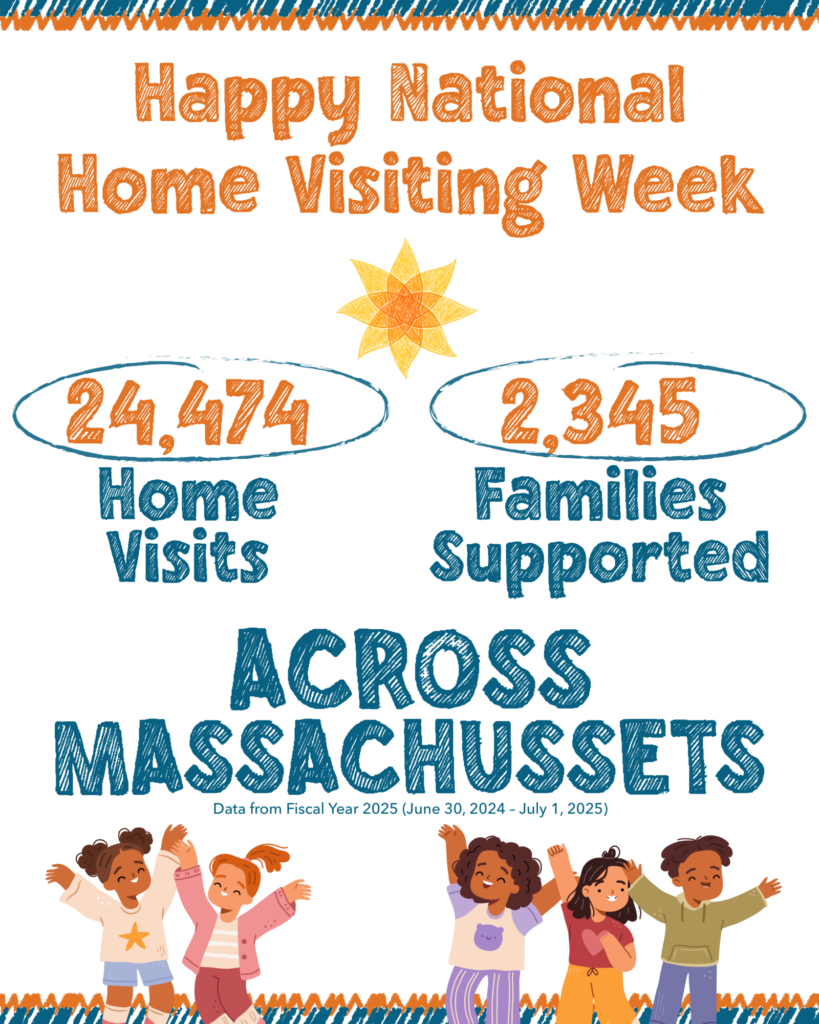
Home visiting programs in Massachusetts serve more than 6,000 families each year. Research shows that participation in Healthy Families Massachusetts, the home visiting program supported by the Children’s Trust, is linked to lower maternal depression, greater housing stability, reduced involvement with child welfare, and stronger child development outcomes. Home visiting is an incredibly powerful and impactful profession, but there remains much confusion about what, exactly, a home visitor does.
At its simplest, a home visitor is a trained professional who partners with families during pregnancy and the early years of a child’s life. But that definition doesn’t quite capture the depth of the role. Home visitors are not just providers of information or connectors to services. They do that work, but more importantly, they are a steady, trusted presence in a period of life that can feel both joyful and overwhelming.
A home visitor might spend part of a visit talking through infant sleep or how to respond to a toddler tantrum, and another part helping a parent think about their own goals like finishing school, finding stable housing, or navigating a new co-parenting dynamic. They might model ways to engage a baby through play, talk through developmental milestones, or help a parent make sense of a challenging moment with their child. They also connect families to resources and just as importantly, they help families feel less alone in figuring it all out.
Over time, something else takes shape. Through consistent visits and ongoing conversations, a relationship builds. Trust grows. A parent who may have been hesitant at first begins to open up. This deep relationship-building is what makes home visiting unique. Home visitors are often with families over months or even years, and because of that continuity, they are uniquely positioned to support families. The home visitor is not there to “fix” anything. They are there to partner – they notice strengths, offer guidance, and walk alongside a family as they build confidence in their own abilities.
And that piece is critical to preventing child abuse and neglect. Much of the family support field is oriented around responding when something has already gone wrong or reached a level of concern. Home visiting shifts that timeline earlier. It focuses on creating the conditions that help families thrive from the beginning – supporting parent-child bonding, reducing stress and isolation, and connecting families to the resources they need before challenges escalate.
The long-term impact of this approach is well documented. A longitudinal study from Tufts University found that participation in Healthy Families Massachusetts led to a 36% decrease in parenting stress and a 32% reduction in secondary reports of abuse and neglect. Families also experienced reductions in substance use and homelessness, alongside increases in employment and educational attainment. Another analysis found that for every dollar invested in the program, the Commonwealth sees a return of $3.11 in future cost savings. The cost savings result from reductions in supports for things like maternal depression, homelessness, and child maltreatment recurrence for program participants.
National research tells a similar story. The National Home Visiting Resource Center reports that families engaged in home visiting are more likely to access prenatal care, have healthier birth outcomes, and adopt safe practices for their infants. They are also less likely to be engaged with child protective services. Parents show more positive interactions with their children, and children experience more support for early learning. Over time, these shifts contribute not just to individual family well-being, but to stronger, more stable communities.
For those considering this path, it is a role that draws on a wide range of skills and backgrounds. Home visitors may come from social work, public health, early childhood education, healthcare, or bring experience as a parent that received and benefited from home visiting. Home visitors often share the cultural background of participants and live within the communities they serve. Programs provide training, reflective supervision, and ongoing support. What matters most, though, is not a specific title or credential. It’s the ability to listen deeply, to build trust, to stay organized and consistent, and to approach families with respect and curiosity.
There is a clear need for more people in this space. In Massachusetts, only 5.3% of eligible children under age three in families with low incomes are currently served by home visiting programs. That gap is significant, especially given what we know about the impact of early support.
For a field that is often stretched thin and asked to do more with less, home visiting offers a compelling example of what it looks like to invest upstream – to support families early, to stay with them over time, and to build the kind of trust that makes lasting change possible. Its effects ripple outward, shaping not just individual outcomes, but the broader systems that support children and families.